
Experiment Instructions
Introduction
Welcome to our economics experiment! In this experiment, you and others will make decisions in a simulated economy.
By participating, you will better understand economic decision-making in a dynamic environment and receive cash. Let’s dive into how you can earn money from this experience.
Overview
First, you will receive $2 for completing these instructions and a few comprehension quizzes. After passing all the quizzes, you will proceed to the main experiment, which is designed to take 60 minutes or less. You will earn points during the experiment based on your and other participants’ decisions. Each point you earn is worth $0.10. The average participant will earn 250 points, but you could earn considerably more or less depending on your decisions.
Experiment Details
In this simulated economy, you will interact with firms, households, and a central bank. You and the other participants will each provide your best inflation predictions and advise computerized households on how to spend and save their money each period. Thus, your decision-making will be spread across three stages: inflation prediction, spending/saving, and reviewing.
Inflation Prediction Stage
Point Prediction
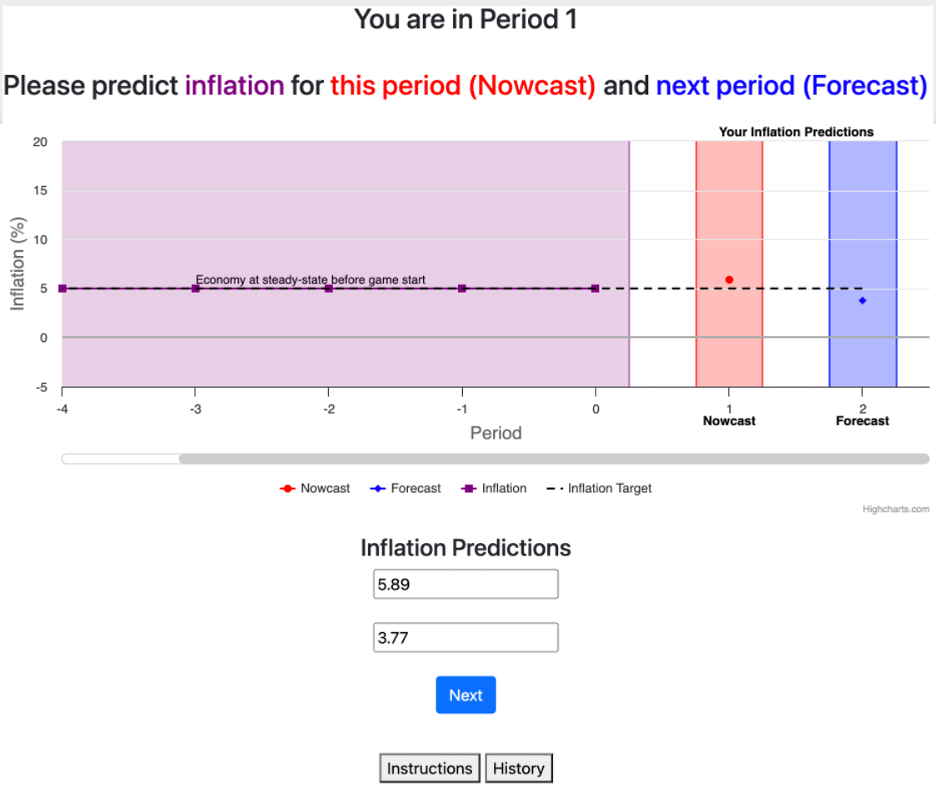
Your first task for each period is to predict current inflation (nowcast) and future inflation (forecast). You will predict the exact value for both nowcast and forecast. In other words, you will be providing a pointprediction. You can enter values directly into the provided forms or use our interactive chart.
Accuracy pays off.
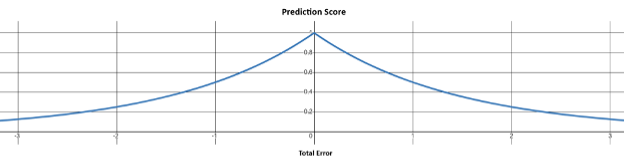
You will earn more points for more precise predictions. A perfect nowcast and perfect forecast earns 2 points each period (1 point for perfect nowcast plus one point for perfect forecast). Every one percentage point error you make will reduce your earned nowcast and forecast points by one-half.
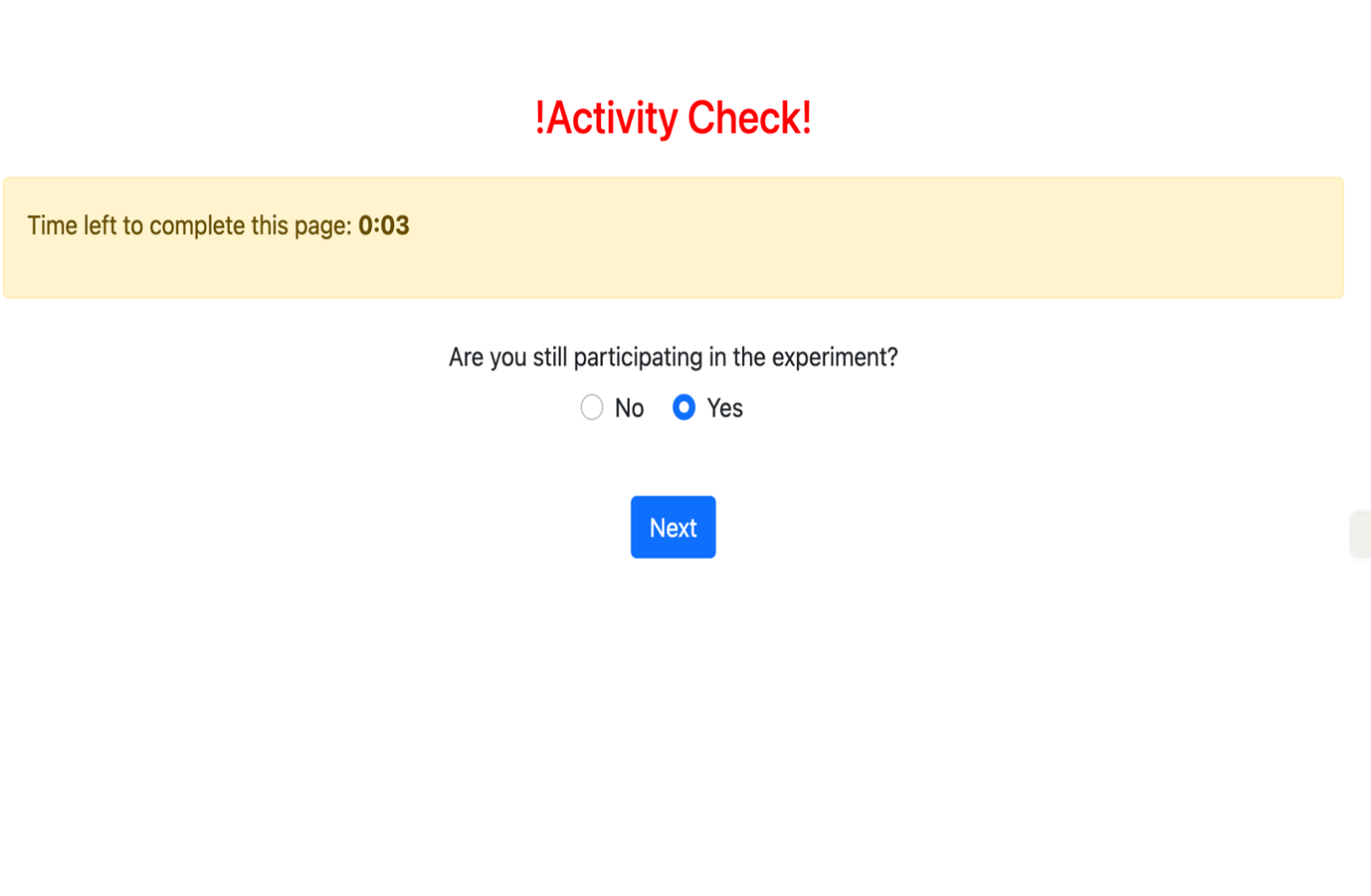
But be quick; you will have 45 seconds (ask Luba and Ryan) to enter both inflation predictions! If you miss the 45-second deadline, your page will jump to the ‘Activity Check’ page like this:
Sometimes, you will submit your predictions faster than other participants. If this happens, you will find yourself on a waiting screen like this:

Finally, if all participants submit their predictions early, you will all move to the next part of the prediction stage immediately.
Range Prediction
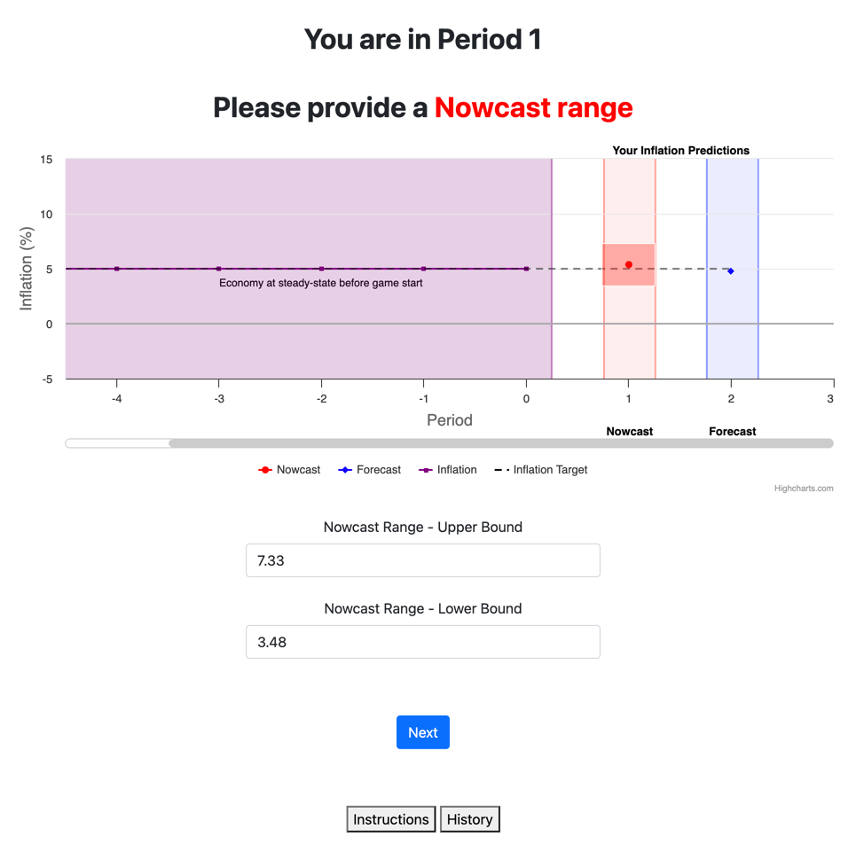
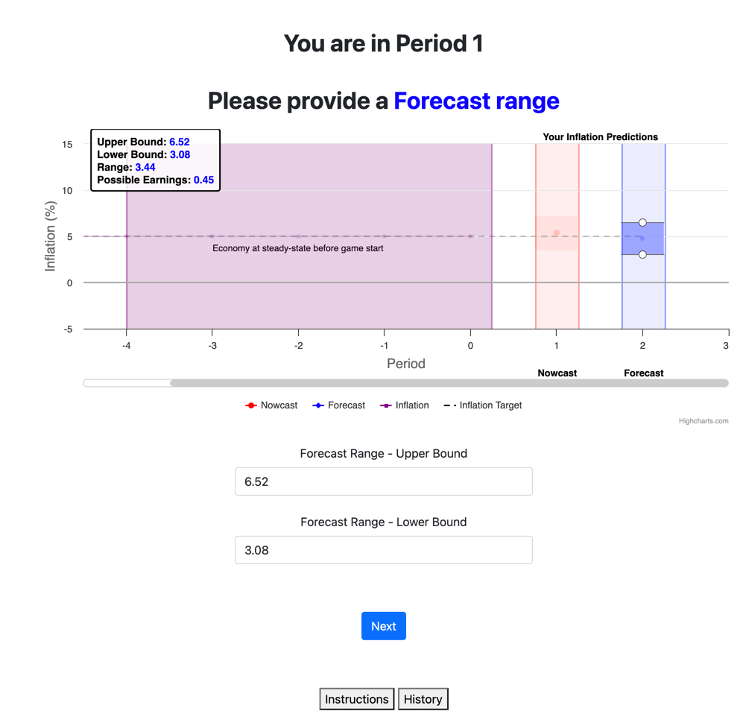
After making your point predictions, you will provide what you think are the highest and lowest possible inflation values for both your nowcast and forecast. In other words, you will provide range predictions. These range predictions must contain your previous point predictions. You have 30 seconds (same as the 45 seconds ask Luba and Ryan, all 45’, all 30’ or keep as is) to submit each range prediction by entering values into the provided forms or moving the interactive range box. Missing the 30-second deadline means progressing without your input and with no points from your range prediction for that period.
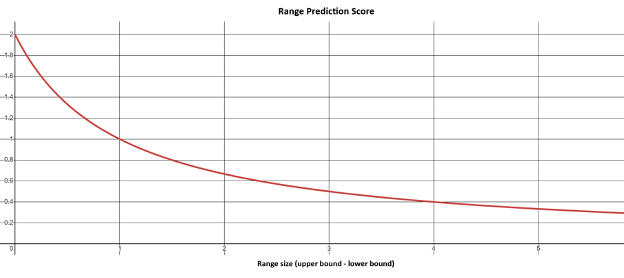
Accuracy matters here, too. If your range prediction includes the actual inflation rate, you are rewarded with points (up to a maximum of 2 points for hitting the mark precisely). But there is a catch: the wider your predicted range, the fewer points you earn. You can mouse over your predictions, and it will show your potential earnings based on the size of your range. This will help you make informed decisions about your predictions. Do not worry about being too off-target; you will not lose points for inaccurate range predictions, but you will not earn additional points if your range is inaccurate or too large.
Spending/Saving Stage
Definitions
- Goods:Items households desire, and firms produce.
- Price: The cost of a single good.
- Households:This economy has three types of households: young, middle-aged, and old. After one period, a young household becomes middle-aged, and a middle-aged household becomes old. Each household type follows a different spending/saving rule:
- Young:Borrow as much as possible and spend it all on consumption.
- Middle-aged:Spend and save according to your advice.
- Old:Spends all the money it had saved from the previous period (plus the interest it earned) on consumption.
- Production of Goods: Your actions, alongside those of other participants, determine the number of goods produced and their prices. The economy can produce a maximum of 7 goods. If the households spend enough that demand exceeds this limit, then the price of goods will increase until supply equals demand. This creates positive inflation. Likewise, prices will fall if households don’t spend enough to warrant the production of 7 goods. This creates negative inflation, also called deflation!
- Inflation Rate: The percentage change in the price of goods between
- Positive inflationmeans prices rise; for example, if prices increase from 20 to 21, this would be (21-20) /20 = 5% inflation.
- Negative inflation means prices decline; for example, if prices decreased from 20 to 19, this would be (19-20) /20 = -5% inflation.
- Zeroinflation means the price remains the same; for example, if prices stayed 20 in two consecutive periods, this would be (20-20) /20 = 0% inflation.
- Inflation Target: The central bank’s desired inflation rate. In other words, the rate at which the central bank would like to see the price of goods increase between two sequential periods.
- Central Bank and Inflation: The central bank aims to maintain inflation as close to its target as possible. The target will be shown to you as a dashed black line on your inflation prediction charts.
- How will the central bank achieve its inflation target?The central bank will adjust the interest rate to steer the economy toward its inflation target.
- If inflation exceeds the target due to increased spending and the price of goods rises, the central bank will respond by raising the interest rate more than one-for-one with inflation, making saving more appealing and slowing down spending.
- Conversely, if spending declines and inflation drops below the target, leading to a smaller increase in the price of goods, the central bank will lower the interest rate to diminish the value of saving, thereby incentivizing more spending.
- This approach, however, has its limits: the interest rate cannot fall below zero. Once the interest rate hits the floor, the central bank’s ability to stimulate spending further and push inflation up is capped.
Households Recommendation
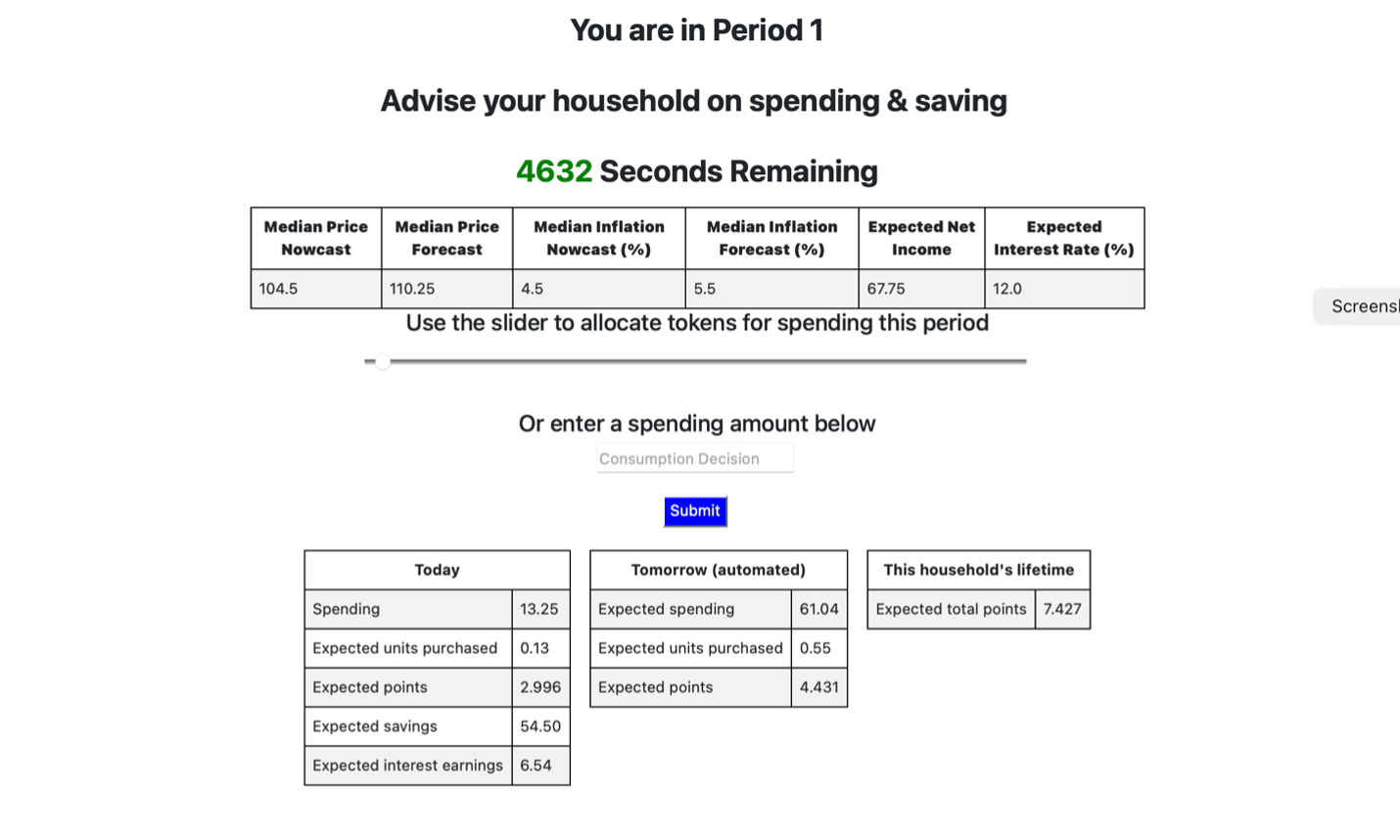
After all participants make their range predictions, you will be assigned to a middle-aged household to help them manage their spending. Your job is to advise them on how to split their income between consuming goods in this period and savings for consuming goods in the next period when they are old and cannot earn income.
Importantly, your advice influences how the middle-aged household behaves in the current and the next period when it becomes old. You can have the household spend nothing, or all its income, or any amount between these two extremes. Whatever income your middle-aged household does not spend in the current period automatically becomes savings. The saving, plus interest earned on this saving, is automatically spent in the next period (when the household becomes old).
As you interact with the slider, observe how the displayed information changes. Moving the slider to the right increases spending and decreases saving. Below the slider, you will see the anticipated points for the current period, the expected savings, the predicted points for the next day, and the total projected points based on the household’s spending level. This real-time feedback allows you to optimize your recommendations for the best possible outcome. Alternatively, if you prefer a more precise approach, you can directly enter a numerical value into the form field. Once satisfied with your advisory decision, confirm it by clicking the red ‘Submit’ button.
You will earn points for each unit of a good the household consumes. You will receive points in the current period (when the household is middle-aged), and you will receive points in the next period (when the household is old).
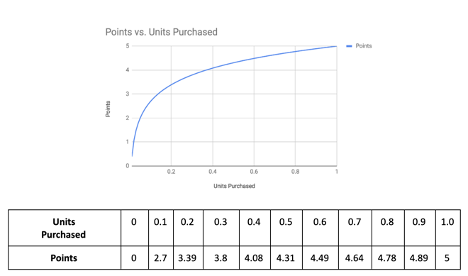
So, why should you ever advise a household to save? The purchasing decisions of households directly impact your earnings. The more goods a household buys in a given period, the more points you earn. But there is a twist to consider—the points gained per good decrease with each additional purchase.
For instance, purchasing 0.1 goods in one period grants you 2.7 points. Further, purchasing 0.2 goods in one period grants you 3.39 points (the additional gain is only 0.69 points). There is a diminishing return, which means sometimes advising a household to save rather than spend can be more beneficial. Consider this scenario: you advise a household to buy 0.2 goods in the current period and 0 goods in the next period, earning a total of 3.39 points. Alternatively, you advise a household to buy 0.1 goods in the current period and 0.1 goods in the next period, earning a total of 5.4 points. Compare these two scenarios; the second option grants you 2.01 more points. (to make it simple, let us assume the interest rate equals to zero)
| Spending strategy | Current period | Next period | Total pointd |
|---|---|---|---|
| Spend all income in the current period | 0.2 goods (3.39 points) | 0 goods | 3.39 points |
| Spend part of your income and save the rest | 0.1 goods | 0.1 goods (2.7 points) | 5.4 points |
Reviewing Stage
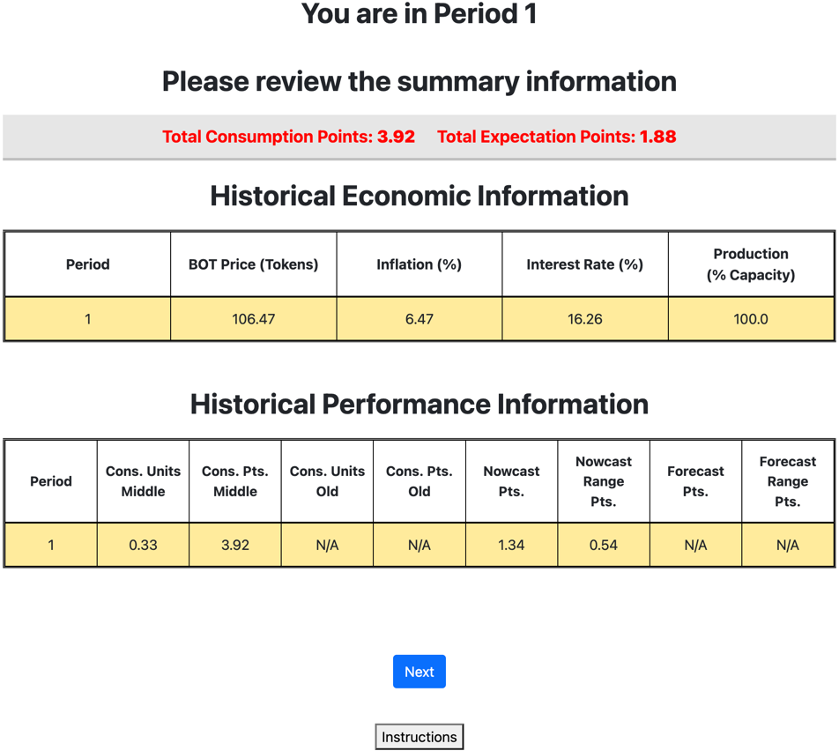
After all participants make their spending recommendations, we will show you a summary screen, which is the last stage in a period. This summary screen provides information about the actual goods’ price, inflation, output, the points you earned for your forecast this period and nowcast last period, your consumption points earned this period, and your total points earned so far in the experiment. The summary screen will contain information about the current period and previous periods. Click the ‘Next’ button to move to the next period.
Game Progression
This process repeats over 30 periods.
Final Quiz and Practice Periods
Before starting the paid experiments, you will complete a final quiz. Pass the quiz, and you will move on to the main experiment.
Payments
Upon completion, payments will be made via Prolific. You will receive a base amount of money plus a bonus converted from your earned points. The exact conversion rate and base fee will be disclosed at the end.
Conclusion
If you move to the main experiment, we will transition you automatically into the paid experiments. Remember, your decisions have real economic implications in our simulated environment.
Good luck and thank you for contributing to our understanding of economic decision-making.